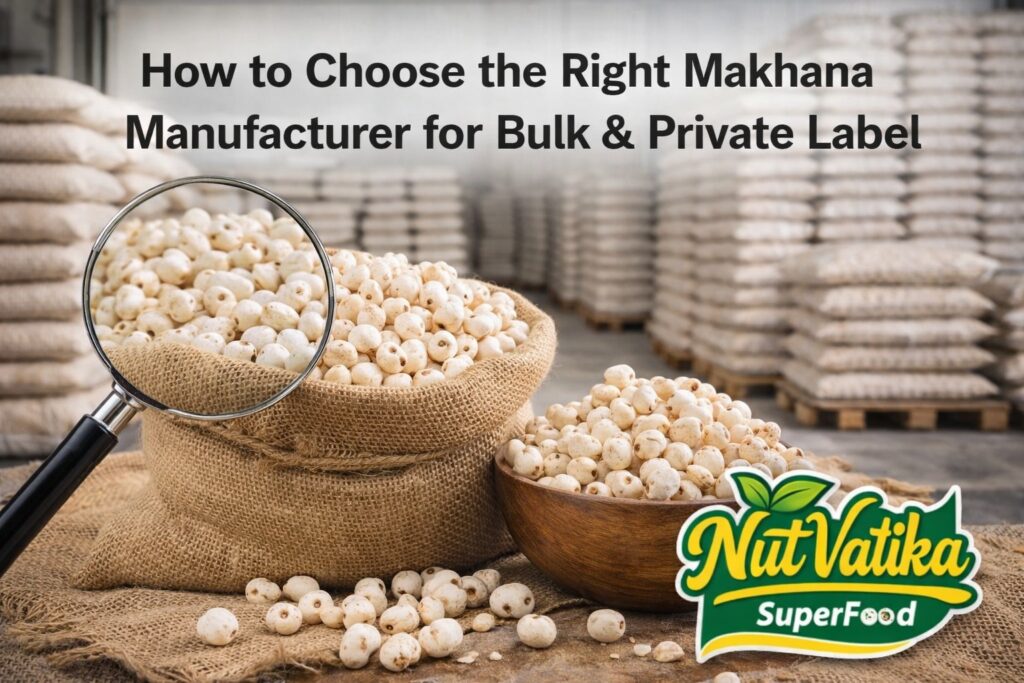
The market for makhana (fox nuts) is expanding quickly in India and international markets. As more consumers choose healthy, plant-based, and gluten-free snacks, the demand for makhana continues to rise. Because of this growth, distributors, wholesalers, food brands, and startups are actively searching for reliable makhana manufacturers who can supply consistent quality in bulk and also support private label Makhana Manufacuting requirements.
However, choosing the right makhana manufacturer is not as simple as comparing prices online. In fact, many buyers face problems after sourcing, such as uneven quality, high breakage, moisture issues, bad odor during storage, or unreliable supply. Therefore, selecting the right manufacturer becomes a critical business decision.
This detailed buyer guide explains how to choose the right makhana manufacturer for bulk and private label using a practical checklist, clear comparisons, and real manufacturing insights. If you want long-term success in the makhana business, this guide will help you make an informed choice.
Why Choosing the Right Makhana Manufacturer Matters
When you buy makhana in bulk or sell it under your own brand, the manufacturer directly affects your reputation. Any quality issue at the production stage eventually reaches your customers. As a result, even one bad batch can lead to complaints, returns, or loss of trust.
Moreover, many buyers experience problems such as inconsistent grades, excess shell residue, moisture retention, or short shelf life. These issues usually do not happen by chance. Instead, they come from poor sourcing, weak processing control, or lack of hygiene standards.
That is why working with a professional makhana manufacturer is essential. A reliable supplier ensures quality consistency, proper grading, safe processing, and timely delivery.
Step 1: Check Raw Makhana Sourcing Carefully
Why sourcing is the foundation of quality
First of all, makhana quality starts at the source. Bihar is the main production hub of makhana in India, especially the Mithila region. Due to favorable soil, water conditions, and traditional farming methods, this region produces superior-quality fox nuts.
Buyer checklist for sourcing
- Does the manufacturer source makhana directly from Bihar?
- Do they work with farmers or long-term aggregators?
- Do they plan procurement during harvesting seasons?
Real manufacturing insight
Reliable manufacturers procure raw makhana during peak harvest periods and store it under controlled conditions. In contrast, traders who rely on open markets often mix produce from different regions and seasons. As a result, buyers receive inconsistent quality, uneven puffing, and variable taste.
Step 2: Understand Makhana Grades Clearly
Why grading causes confusion for buyers
Many buyers assume that larger makhana automatically means better quality. However, size alone does not define grade. In reality, grading depends on multiple factors that affect appearance, cooking behavior, and shelf life.
Key grading parameters
- Puff size and density
- Weight consistency
- Breakage percentage
- Shell and dust residue
- Color uniformity
Buyer checklist for grading
- Does the manufacturer clearly define each grade?
- Are grades supplied separately or mixed?
- Can grades be customized according to your market needs?
Comparison insight
Low-cost suppliers often mix grades to reduce pricing. On the other hand, professional makhana manufacturers maintain strict grade separation. Therefore, buyers get uniform batches that perform consistently during roasting, packing, and resale.
Step 3: Evaluate the Makhana Processing Method
Why processing impacts shelf life and safety
After sourcing, processing plays a major role in determining final quality. Poor Makhana processing stepts often leads to moisture retention, bad odor, and faster spoilage.
Buyer checklist for processing
- Is the makhana machine-cleaned?
- Is shell dust completely removed?
- Is moisture level checked after processing?
Real manufacturing insight
Good manufacturers combine traditional popping methods with modern machine cleaning, air sorting, and controlled drying. As a result, their makhana remains fresh for longer periods and performs better during storage and transportation.
Step 4: Review Hygiene and Food Safety Standards
Why hygiene is non-negotiable
Bulk buyers and private label brands must meet food safety regulations. If the manufacturer ignores hygiene, your business faces serious risk.
Buyer checklist for hygiene
- Is the manufacturing unit FSSAI registered?
- Are food-grade surfaces used?
- Is pest control regularly maintained?
Comparison insight
Small traders usually operate from open or residential spaces with limited hygiene controls. In contrast, professional makhana manufacturers follow structured cleaning procedures and basic food safety practices, which reduces contamination risks.
Step 5: Assess Bulk Packaging and Shelf Life Control
Why packaging matters for bulk buyers
Makhana easily absorbs moisture from the environment. Therefore, poor packaging leads to spoilage, odor, and breakage.
Buyer checklist for packaging
- Are 25 kg or 50 kg bulk packs available?
- Are food-grade inner liners used?
- Is export-grade packaging offered if required?
Real manufacturing insight
Export-ready manufacturers use moisture-barrier packaging and proper sealing methods. As a result, the product remains stable during long-distance transport and extended storage.
Step 6: Check Private Label Capabilities
Why private label support is important
If you plan to build a brand, you need more than bulk supply. You also need consistent quality, proper packaging, and compliant labeling.
Buyer checklist for private labeling
- Do they support custom branding and packaging?
- Is labeling compliant with regulations?
- Are MOQs suitable for startups?
Comparison insight
Many suppliers claim to offer private label services but only provide basic packing. However, experienced manufacturers support brand-ready packaging, consistent batches, and accurate labeling for retail or export markets.
Step 7: Understand Pricing and Cost Drivers
Why makhana prices vary widely
Makhana pricing depends on several factors. Therefore, buyers should understand pricing logic instead of focusing only on low rates.
Key pricing factors
- Grade and size
- Cleaning and sorting level
- Seasonal availability
- Packaging type
- Order quantity
Buyer checklist for pricing
- Is pricing grade-specific?
- Are processing and packaging costs explained?
- Are seasonal price changes communicated clearly?
Real manufacturing insight
Very low prices often indicate mixed grades, higher moisture, or poor cleaning. Reliable manufacturers maintain transparent and stable pricing to protect long-term relationships.
Step 8: Review MOQ, Lead Time, and Supply Reliability
Why supply planning matters
Unreliable supply can disrupt your sales and damage customer trust.
Buyer checklist for supply
- What is the minimum order quantity?
- Can the manufacturer handle repeat orders?
- Is lead time consistent?
Comparison insight
Established manufacturers maintain buffer stock and production planning. In contrast, traders depend on spot purchases, which often leads to delays and inconsistency.
Step 9: Evaluate Export Readiness
Why export capability is important
If you plan to sell makhana internationally, your supplier must understand export requirements.
Buyer checklist for export
- Do they support export documentation?
- Is export-grade packaging available?
- Do they understand shelf-life labeling?
Real manufacturing insight
Export-ready manufacturers test moisture levels, maintain traceability, and follow destination-specific rules. Therefore, shipments face fewer quality issues at ports.
Step 10: Always Test Samples Before Finalizing
Why sample testing is essential
Samples reveal real quality better than specifications.
Buyer checklist for samples
- Are samples provided before bulk orders?
- Does bulk supply match sample quality?
- Is consistency maintained across batches?
Trader vs Professional Makhana Manufacturer Comparison
| Aspect | Local Trader | Professional Manufacturer |
| Sourcing | Open market | Controlled sourcing |
| Grading | Mixed | Defined and uniform |
| Hygiene | Limited | Food-grade standards |
| Packaging | Basic | Bulk and export-ready |
| Private Label | Limited | Full support |
| Supply | Unstable | Reliable |
FAQs (Short Snippet Version)
What is the best makhana grade for bulk buyers?
The best grade depends on your market. Premium brands prefer large, uniform makhana, while value segments choose medium grades for cost efficiency.
Why does bulk makhana price vary between suppliers?
Prices vary due to grade, cleaning level, seasonality, moisture control, and packaging quality. Very low prices often mean compromised quality.
What is the shelf life of bulk makhana?
Bulk makhana typically has a shelf life of 6–12 months when properly processed, packed, and stored in dry conditions.
Why is Bihar-sourced makhana preferred by bulk buyers?
Bihar makhana offers better puffing quality, uniform size, and clean taste due to favorable soil and water conditions, especially in the Mithila region.
Choose the Right Manufacturing Partner
If you are looking for a reliable makhana manufacturer in Bihar for bulk supply or private label, choose a partner who focuses on quality, hygiene, and consistency.
👉 Contact us to discuss your makhana sourcing needs
